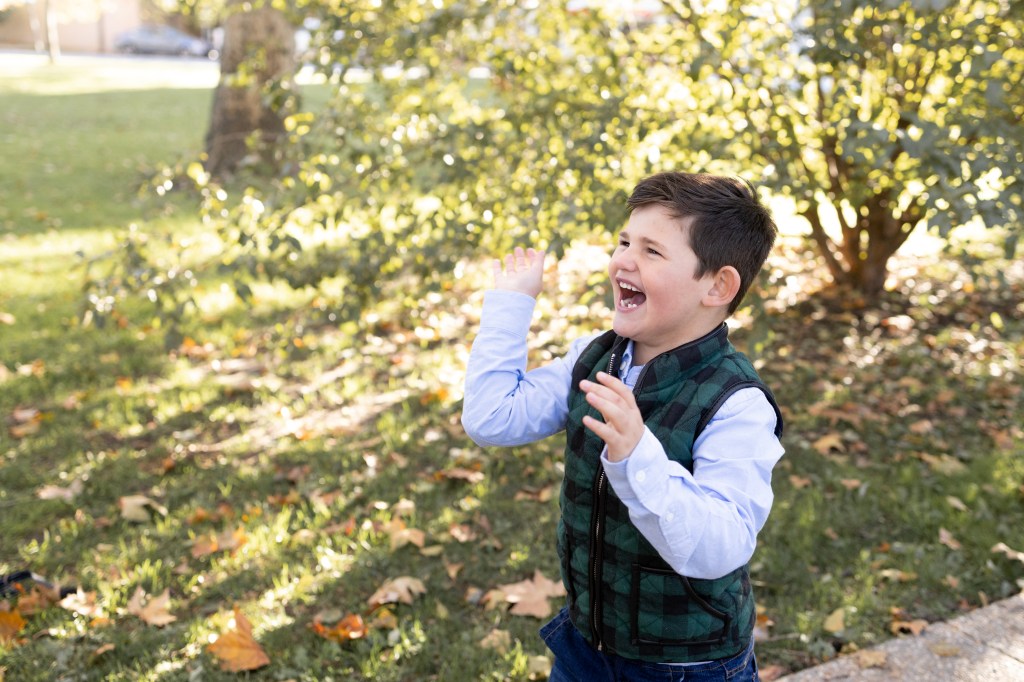
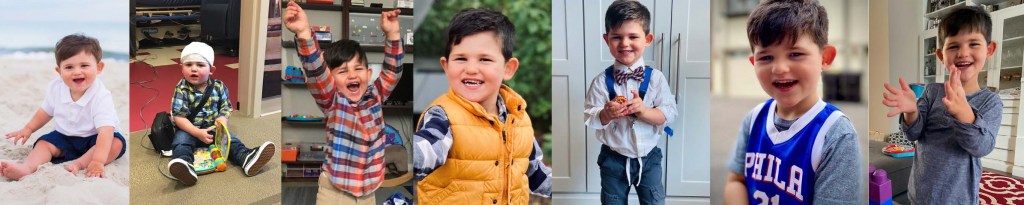
Gabe has an infectious smile. He is compassionate with an endless supply of warm hugs. He is a very social and engaging child but he does not speak. He uses gestures, some American Sign Language, eye contact, sounds, and his augmentative and alternative communication (AAC) device to communicate.
Journey to Diagnosis
Gabriel was diagnosed with Angelman syndrome (AS) just before his second birthday. We noticed he was missing traditional developmental milestones at 7 months old and started him with early intervention. He was getting speech therapy at 9 months old for feeding and oral sensory issues. By 11 months old, he was receiving physical therapy for hypotonia or decreased muscle tone which is confusing because he is unusually strong, though the two are unrelated. Occupational therapy then started to focus on fine motor moments. Special instruction services were initiated to help with his educational and social skills at daycare. At 18 months old, he was not walking or talking. A series of doctor visits with developmental pediatricians, neurologists, and geneticist led to an MRI, EEG, and microarray genetic testing that would bring “Angelman syndrome” into our lives forever.
Rare Disease
Angelman syndrome is a rare genetic disorder that affects about 500,000 people worldwide. AS involves a disruption to the UBE3A gene on the 15th chromosome. Individuals living with AS can have balance issues, motor impairments, seizures, global development delays, sleep disorders, and lack of speech. Gabe has a type of AS called Uniparental Disomy (UPD). This genotype effects about 3-7% of individuals with AS. He has global developmental delays, motor and balance problems, sleeping difficulty, anxiety, impulsivity, hyperactivity, and a lack of speech.
Today
Gabe attends our local elementary school. He gets lots of help everyday, learns new skills, gets exposure to a variety of subjects, and makes new friends. When he’s not at school he gets therapy at home, loves playing games on his ipad, enjoys scrolling through pictures and videos of his family, plays with puzzles, watches buses and trucks go by from the window, plays with play-doh and kinetic sand, and loves doing anything with Daddy. Gabriel also has a service dog named Xander who provides him with companionship, pressure therapy, assists with mobility, and so much more.
A Cure
AS is a single-gene disorder caused by a loss of function in the UBE3A gene on the maternal 15th chromosome. Researchers are confident there will be a successful treatment(s) within Gabe’s lifetime. There are multiple ongoing clinical trials that can make a difference. We believe that is something to smile about! Please consider donating for a cure.
 Angelman Gabriel